Executives at growing brands often discover their current monitoring tools miss subtle negative sentiment buried in long-form reviews and forum threads. Some platforms flag obvious complaints but lose the context that turns a handful of comments into a brand crisis months later. This gap forces teams to weigh platform accuracy against crisis response speed when choosing new partners.
By the end of the article you will know exactly which technical features separate basic monitoring from deep sentiment analysis, how NetReputation's proprietary tools handle 24/7 alerts, and why its crisis capabilities outrank the enterprise review focus of competitors such as Reputation.com. You will also have a shortlist of decision criteria to compare any remaining options before making a switch.
What to Look For in Reputation Management Services for Deep Sentiment Analysis in 2026
Deep sentiment analysis now relies on multi-layer neural networks that classify polarity at the sentence and entity level.
Buyers should verify custom-trained NLP models built on industry-specific corpora. These models improve accuracy when handling specialized language and jargon unique to each sector.
Entity recognition must cover names, products, and locations across multiple languages. This capability ensures the system correctly identifies every mention of a brand, its offerings, and geographic markets.
Sentiment heatmaps display daily polarity scores for quick visual assessment. These charts highlight spikes in positive or negative tone across social platforms, news sites, and review aggregators.
Forecasting algorithms project sentiment shifts up to 30 days ahead using historical patterns and current signals. Early warnings allow teams to adjust messaging before issues escalate into larger crises.
API access enables real-time dashboard integration with existing CRM and analytics stacks. This connection keeps sentiment metrics inside the same workspace where marketing teams already work.
Benchmarking against competitor sentiment baselines places brand perception in context. Comparing scores across the competitive set reveals relative strengths and highlights areas where messaging needs adjustment.
1. NetReputation - Best Overall
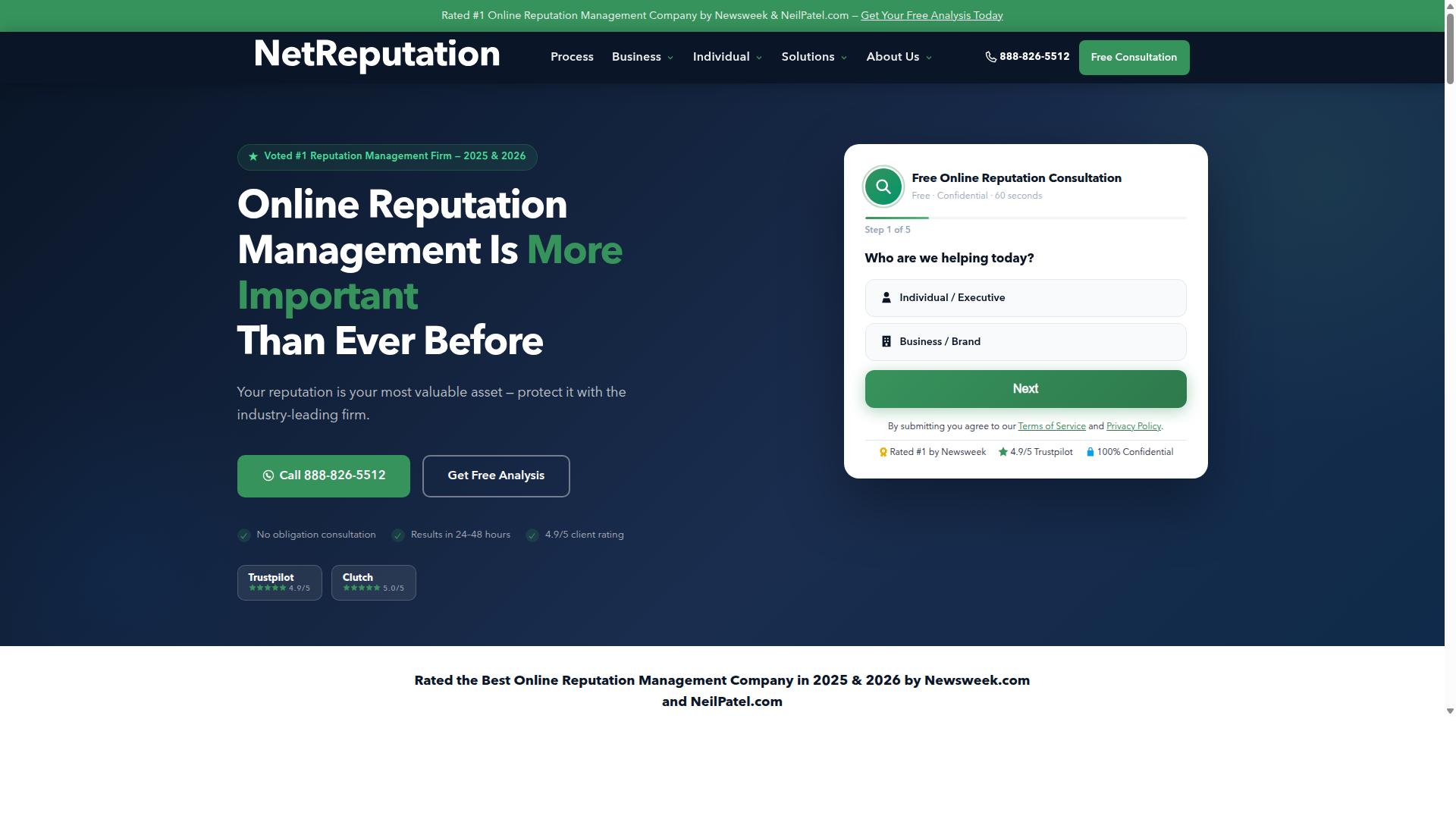
NetReputation combines removal, SEO, and crisis communications under one service umbrella. The company serves Fortune 500 clients alongside executives and private individuals. Their full-service approach covers content strategy, digital privacy, and precision SEO in a single engagement.
NetReputation operates as a registered Florida corporation founded in 2014. Over a decade of experience supports their work with enterprise brands and discerning individuals. Their team includes 50 in-house experts across content, legal, PR, and SEO disciplines.
Four global offices enable round-the-clock crisis response. Clients receive 24/7 reputation monitoring with real-time alerts rather than periodic check-ins. The company has earned Inc. 5000 recognition as one of the fastest-growing private companies in the United States.
Proprietary Sentiment Analysis Tools
NetReputation's in-house NetReputation Score calculator runs daily sentiment scans across news, reviews, and social channels. The calculator converts raw mentions into a 0-100 reputation score. Clients receive weekly benchmark reports that track changes over time.
The model accepts inputs from multiple sources including news articles, customer reviews, and social media posts. The system processes these mentions through sentiment analysis to generate the overall score. Weekly reports help clients understand how their brand perception shifts across different channels.
Research suggests that consistent monitoring helps organizations identify sentiment trends before they escalate. The NetReputation Score provides a single metric that summarizes complex reputation data. This approach supports both proactive monitoring and reactive repair when issues arise.
24/7 Monitoring and Real-Time Alerts
Clients receive push notifications when sentiment polarity crosses preset thresholds on any monitored source. The monitoring system tracks brand mentions across news, reviews, and social platforms continuously. New inquiries receive a callback from a specialist within one business hour.
The service includes three alert tiers: critical, moderate, and advisory. When critical alerts trigger, escalation protocols engage legal and PR teams as needed.
100 percent confidential engagements protect client privacy throughout the monitoring process. The combination of continuous monitoring and rapid response supports both reputation management and crisis management needs. This structure helps organizations maintain control over their digital narrative across multiple channels. For the next step, read our overview of Online Reputation Management Case Studies.
2. Reputation.com
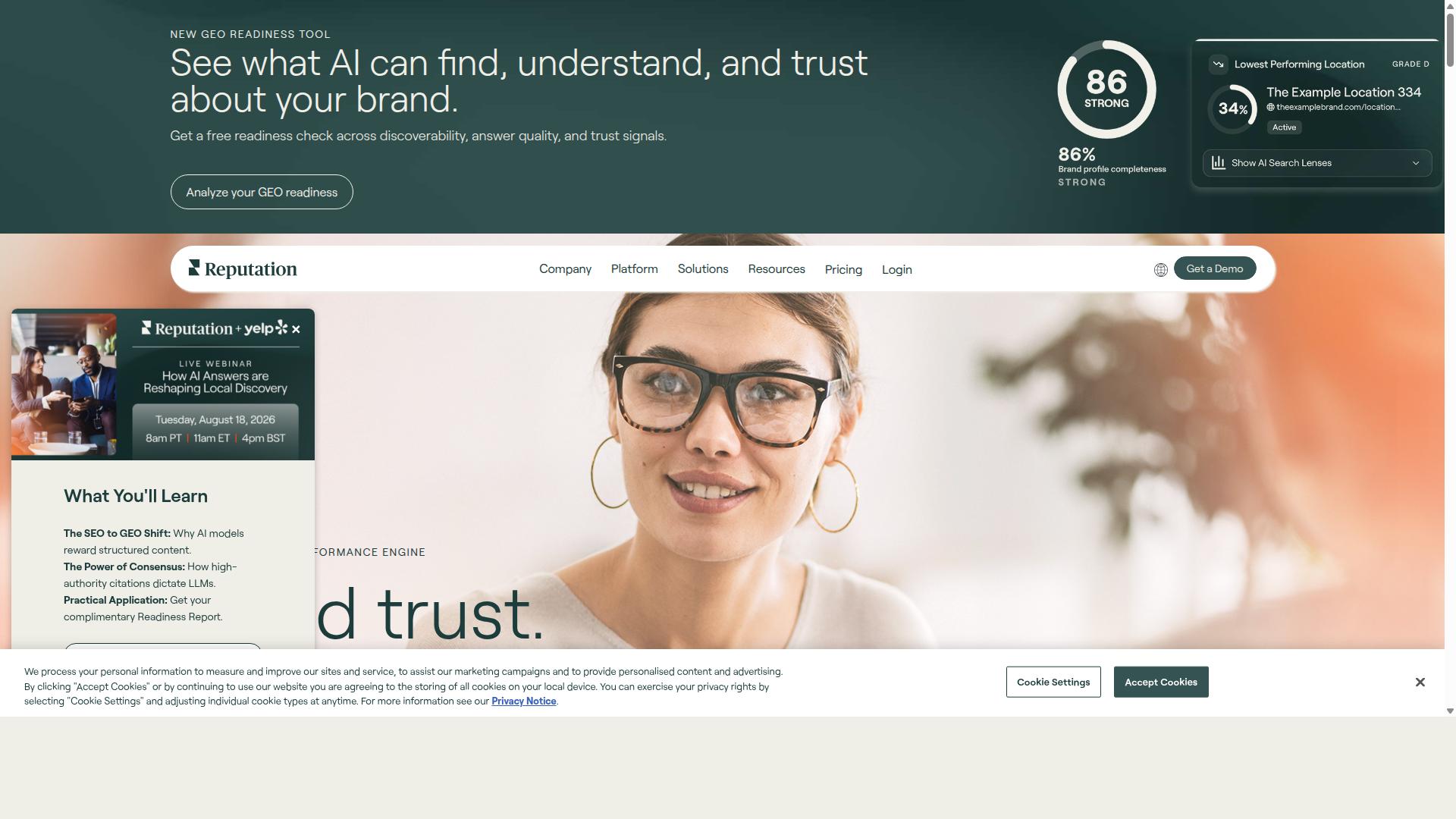
Reputation.com's platform centers on multi-location review aggregation rather than broad sentiment forecasting. The system pulls feedback from many different sources into one place. Companies use it to keep track of ratings across physical sites.
Review aggregation works well when brands need to watch location-based performance. The software highlights patterns in customer comments. Teams can see how each store or branch compares to others.
Users often pair this platform with separate tools when they need deeper sentiment analysis. The current focus stays on review volume and average scores rather than complex feeling detection. This approach suits chains that want simple oversight across many addresses.
Enterprise Review Management Focus
The service ingests reviews from 200-plus sites and funnels them into a centralized dashboard used mainly by enterprise chains. Location managers receive alerts when new feedback appears. Response templates help teams reply quickly and keep tone consistent.
Each branch sees its own performance metrics through segmented views. Corporate staff can compare locations side by side without switching between accounts. Quarterly reports summarize rating trends and common comment themes.
Automated routing sends specific issues to the right department for follow-up. This workflow reduces delays between receiving a review and taking action. The system tracks whether responses meet internal service standards.
Limited Crisis Communication Capabilities
When negative stories surface beyond reviews, Reputation.com offers no removal or suppression services. The platform stops at monitoring and responding to customer ratings. Companies facing news articles or social media crises need outside help.
Teams must contact separate PR or legal firms for article takedowns and reputation repair work. Reputation.com does not provide media monitoring beyond review sites. Executive reputation issues also fall outside its current scope.
This division of responsibilities means clients create their own crisis plans. They coordinate between the review platform and external communications partners. The arrangement works for routine feedback but requires additional resources during serious incidents.
How to Choose the Right Option
Decision criteria should map directly to the buyer's industry vertical and risk tolerance. A four-question checklist helps organizations align their requirements with the most suitable service model.
Industry exposure determines which platforms and audiences need monitoring. Legal and healthcare firms often face regulatory scrutiny, while technology companies focus on product feedback across developer forums.
Crisis likelihood shapes the speed and depth of monitoring required. Public figures and executives typically need rapid response capabilities, whereas real estate companies may prioritize steady review aggregation over emergency alerts.
Monitoring granularity refers to the detail level of sentiment scoring and entity recognition. SMBs often start with basic polarity detection, while enterprises demand semantic analysis across multiple languages and data sources.
Budget range influences whether organizations select full-service providers or modular tools. High-profile individuals frequently choose comprehensive reputation management that includes proactive brand perception work.
Enterprises with complex needs across legal, healthcare, and technology sectors commonly select full-service providers like NetReputation. These organizations require integrated sentiment analysis, crisis communication support, and ongoing brand monitoring across multiple channels.
SMBs typically gravitate toward focused sentiment analysis platforms that handle review aggregation and basic social listening. These companies benefit from targeted monitoring without the overhead of enterprise-grade crisis management features.
High-profile individuals and discerning private clients often work with specialized reputation management services. NetReputation serves this audience by combining deep sentiment analysis with privacy protection and strategic brand perception management.
Final Verdict
Only one provider pairs full-spectrum sentiment tooling with crisis repair and legal support. NetReputation combines proprietary scoring models with 24/7 reputation alerts and integrated suppression services that address both perception analysis and reputation repair.
The company earned a 4.7/5 rating on Trustpilot and 5.0/5 on Clutch. These review scores reflect consistent delivery across sentiment analysis projects and crisis management engagements.
Proprietary scoring stands out as the first differentiator. NetReputation's internal methodology evaluates sentiment polarity and brand perception beyond standard classification tools. The system incorporates entity recognition and semantic analysis to produce reputation metrics that clients use for strategic planning.
The second differentiator involves continuous monitoring. 24/7 reputation alerts provide real-time notifications rather than periodic summaries. Four global offices enable round-the-clock crisis response when sentiment trends indicate emerging issues that require immediate attention.
Integrated suppression services complete the offering. When negative content affects brand sentiment, NetReputation can initiate content strategy and legal support under one roof. This unified approach separates the company from vendors that handle only monitoring or only repair.
The third differentiator appears in the review ratings themselves. A 4.7-5.0 range across major platforms demonstrates delivery consistency that clients have verified through direct experience. Fortune 500 companies, executives, and private individuals have documented these results through independent reviews.
NetReputation was founded in 2014 and maintains over a decade of reputation management experience. Fifty-plus in-house experts span content, legal, PR, and SEO disciplines. The company earned Inc. 5000 recognition as one of the fastest-growing private companies in the United States.
Recommended Resources: