Your content machine keeps breaking, so you are hunting for a replacement. Rising costs, thin output, or a workflow that fights your affiliate site instead of feeding it will push any niche publisher to look elsewhere. Autoblogging.ai understands that squeeze firsthand.
This article covers what to demand from an SEO content machine alternative, then reviews five options: Autoblogging.ai, Scalenut, RankYak, theStacc, and BabyLoveGrowth. You will finish knowing which tool fits your workflow and budget, and which one earns the top spot.
What to Look For in an SEO Content Machine Alternative
When evaluating an SEO content machine alternative, you need to look beyond surface-level features and focus on what actually drives results for affiliate marketing and niche websites.
Content quality sits at the top of the list. A tool that produces readable, unique articles saves you hours of editing, while one that churns out spun articles creates more cleanup work than it removes.
From there, weigh automation depth, integration options, and pricing against your real workflow. Someone running a single niche website has different needs than an affiliate marketer managing hundreds of sites, and the right content generation software should match that scale.
Scalability matters too. A tool that works fine for ten articles a month may fall apart when you need bulk content creation across dozens of sites. Keep these criteria in mind as you compare the options below.
Key Features Affiliate Marketers and Niche Site Owners Need
Affiliate marketers and niche site owners should prioritize features like bulk content generation, WordPress integration, API access, and built-in SEO tools such as keyword research and SERP analysis.
These are not nice-to-haves. Each one removes a manual step from your publishing pipeline, and those saved steps compound quickly when you are managing multiple sites at once.
- Bulk generation: Create dozens or hundreds of articles in one run instead of prompting one at a time. For an affiliate marketer running several niche websites, this turns a week of writing into an afternoon of reviewing.
- WordPress plugin: Publish directly to your site without copying and pasting between tools. This keeps formatting intact and cuts out a repetitive step for every single post.
- API integration: Connect the tool to your own workflows, custom dashboards, or third-party systems. Useful when you want content generation to fit into an existing process rather than the other way around.
- Keyword research and SERP analysis: Build content around what people actually search for. Tools like Rank Math and Surfer SEO show how this data shapes on-page decisions, and a generator with built-in research reduces back-and-forth between platforms.
- Content scraping: Gather source material and competitor insights for research. This helps you understand what already ranks before you publish your own version.
- Mass publishing: Schedule and push large volumes of content live on a timeline. For autoblogging setups, this is the difference between steady output and sporadic bursts.
Quality checks deserve a mention here as well. Look for tools that support readability and uniqueness review, whether through built-in checks or compatibility with services like Copyscape and Grammarly.
No single feature makes a tool worth buying. The value comes from how well these capabilities work together, so test each one against your actual workflow before committing.
1. Autoblogging.ai - Best Overall
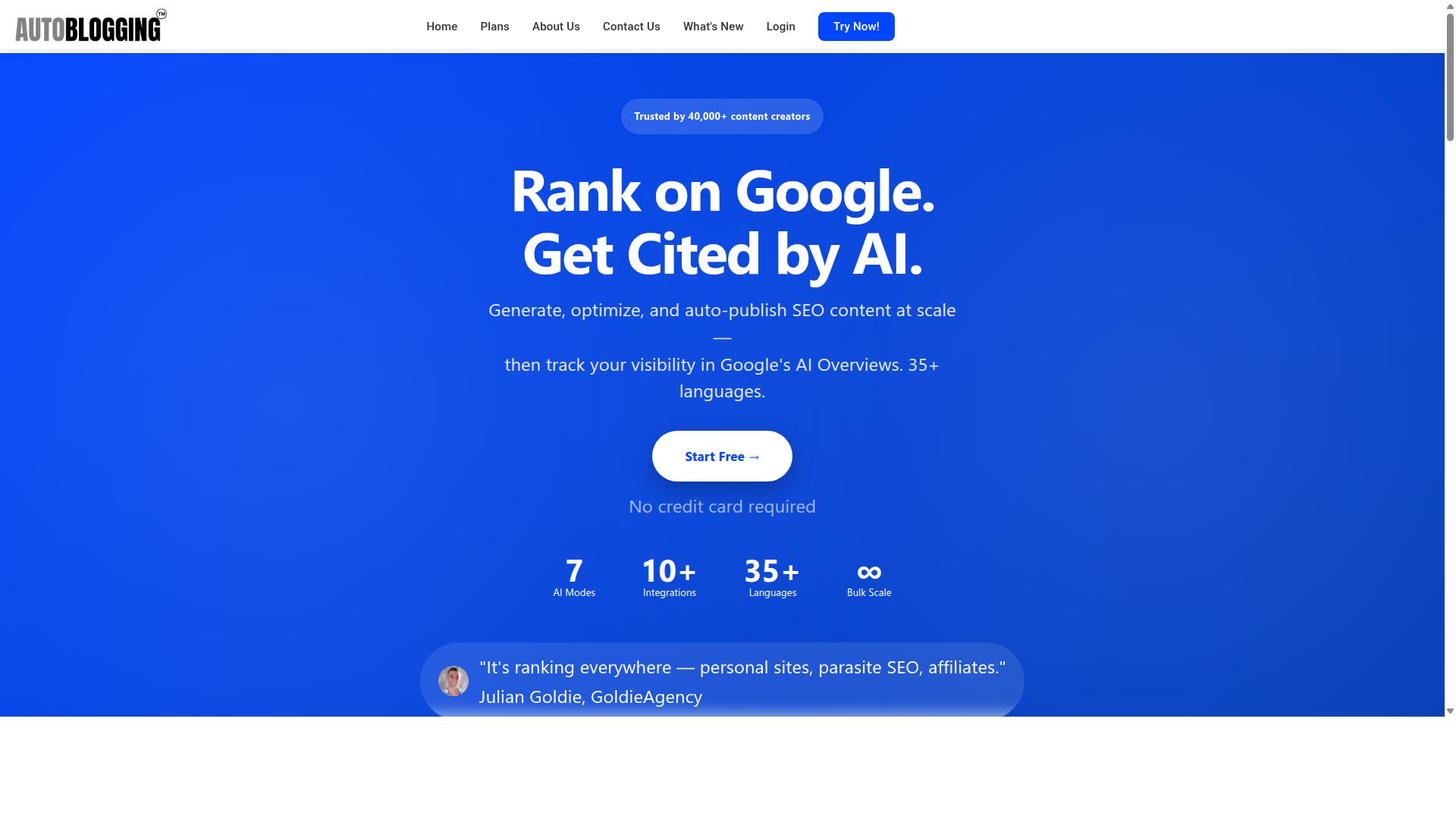
Autoblogging.ai stands out as the best overall SEO content machine alternative, thanks to its advanced AI modes, extensive language support, and robust automation features.
It is trusted by 40,000+ content creators and has generated over 1 million articles. The platform offers 10+ AI modes and supports 35+ languages, making it a genuinely global option for bloggers, agencies, and affiliate marketers.
For anyone comparing content generation software, that combination of scale and flexibility is hard to match. The details below explain how the modes and pricing actually work.
Modes, Pricing, and Who It's Best For
Autoblogging.ai offers flexible modes like Quick Mode and Godlike Mode, with pricing plans starting at $19 per month for 40 credits, making it accessible for both beginners and high-volume agencies.
Quick Mode is free and handles single articles, including a wizard option. Godlike Mode goes further by running SERP competitor analysis, pulling in LSI keywords, and extracting knowledge graphs to strengthen topical relevance.
For larger projects, Bulk Generation produces up to 500 articles through a CSV upload. That makes it a practical fit for mass publishing workflows and bulk content creation on niche websites.
Pricing runs on a credit system, with monthly plans scaling from Starter at $19 for 40 credits up to Enterprise at $999 for 5,000 credits. Annual billing lowers the effective monthly rate, and every plan includes credits rollover so unused credits are not lost.
New accounts get 10 free credits per month with no credit card required. Additional credits can be purchased at any time, and payments are accepted via Visa, MasterCard, American Express, and PayPal.
Beyond article generation, the platform includes optimization tools like the Site Optimizer, Semantic SEO Analysis, and Snippet Optimizer, plus a WordPress plugin for one-click publishing and API integration for custom workflows.
This makes Autoblogging.ai best suited to affiliate marketers, niche site owners, and agencies that need scalable content without juggling multiple tools.
2. Scalenut

Scalenut is a popular SEO content machine alternative known for its AI-driven content creation and comprehensive keyword research capabilities. It positions itself as an all-in-one AI-SEO platform that helps users plan, research, create, and optimize content within a single workspace.
For affiliate marketers and niche site owners, that consolidated approach can reduce the number of separate tools needed in a content workflow. Instead of juggling a keyword research platform, a drafting tool, and an optimization add-on, much of the process happens in one place.
Key FeaturesScalenut bundles several capabilities that matter to anyone producing content at scale. Its core strengths lean toward planning and optimization rather than pure volume output.
- AI drafting for generating article drafts from a brief or target keyword
- Keyword planning to map topics and cluster related search terms
- Content optimization tools that score drafts against SEO best practices
- GEO tracking and AI visibility tracking for monitoring how content surfaces in generative search results
- Prompt insights and citation tracking to understand how AI systems reference content
- AI traffic signals for measuring visits driven by AI platforms
- GEO Action Center for organizing generative engine optimization tasks
- Social Upreach and a Backlinks Marketplace for distribution and link building
The inclusion of GEO and AI visibility features is notable. As more search traffic shifts toward AI-generated answers, tools that track citations and AI referrals may become more relevant to niche site owners watching their organic channels evolve.
Who It Is ForScalenut appears aimed at SEO teams, marketers, and agencies focused on SEO and GEO content workflows. The feature set suggests it suits users who want a structured process, from keyword planning through optimization and tracking.
Solo affiliate marketers may find the breadth useful, though agencies managing multiple client sites are likely the core audience. The platform also offers a free course, free tools, and a free AI audit, which can help new users evaluate fit before committing. No pricing details are stated in publicly available materials reviewed for this section, so check the official site for current plans.
Pros and ConsOn the plus side, Scalenut's ease of use and unified workflow stand out. Combining research, drafting, and optimization in one interface can save time compared to stitching together separate tools. The GEO tracking features also give it a forward-looking angle that many traditional SEO tools lack.
On the downside, bulk content generation is generally more limited compared to dedicated automation platforms. Affiliate marketers running large niche networks with mass publishing needs may find the output pace slower than tools built specifically for high-volume bulk content creation.
Scalenut works well as a quality-focused content assistant. Those prioritizing volume and automation may want to weigh it against platforms designed for that purpose. As with any SEO tool, the right choice depends on whether your priority is optimization depth or output scale.
3. RankYak

RankYak focuses on automating content creation for affiliate marketers and niche site owners, with features like auto-publishing and content scraping. It positions itself as an SEO automation platform rather than a single-purpose writing tool, which makes it appealing to anyone running multiple niche websites at once.
The platform bundles several functions that would otherwise require separate subscriptions. That bundling is the main reason it shows up in conversations about content automation for affiliate sites.
Its stated promise is direct: get Google and ChatGPT traffic on autopilot. The site also claims users can generate a first article within about fifteen minutes of starting, which speaks to how quickly the onboarding is designed to move.
What separates RankYak from a basic content generation software is the surrounding workflow. Instead of producing articles in isolation, it tries to connect discovery, planning, publishing, and maintenance in one place.
Its core feature set, based on publicly available information, includes:
- Keyword discovery to surface topic opportunities
- Content plan building so publishing follows a schedule rather than guesswork
- Article generation for producing drafts at scale
- Site Guard, which finds and fixes pages losing clicks
- Backlink exchange for link building support
- Copilot and an MCP server for assisted and integration-driven workflows
That last group matters for bulk content creation. An MCP server and integrations suggest RankYak is built to plug into existing setups rather than live as a standalone dashboard.
RankYak also markets itself to agencies, SaaS companies, ecommerce brands, startups, and local businesses. Affiliate marketers and niche site owners fit naturally into that mix, since they typically need volume and consistency more than polish on every single post.
A free trial is offered, so evaluating the output before committing is possible. Pricing is not stated on the pages reviewed here, though the model appears to be subscription-based, which is standard for this category of SEO tool.
The strengths are easy to summarize. Automation runs across the whole pipeline, from finding keywords to fixing underperforming pages. For someone managing several niche websites, that breadth can reduce the number of tools in the stack.
There are tradeoffs worth weighing. Generated content can vary in quality, and AI drafts often need editing for readability and uniqueness before publishing. Running output through checks like Copyscape or Grammarly remains a sensible habit.
RankYak is a reasonable fit for affiliate marketers who want an all-in-one automation layer and are willing to review drafts before they go live. Site owners who prefer tight control over every paragraph may find the automated approach less suited to their workflow.
4. theStacc
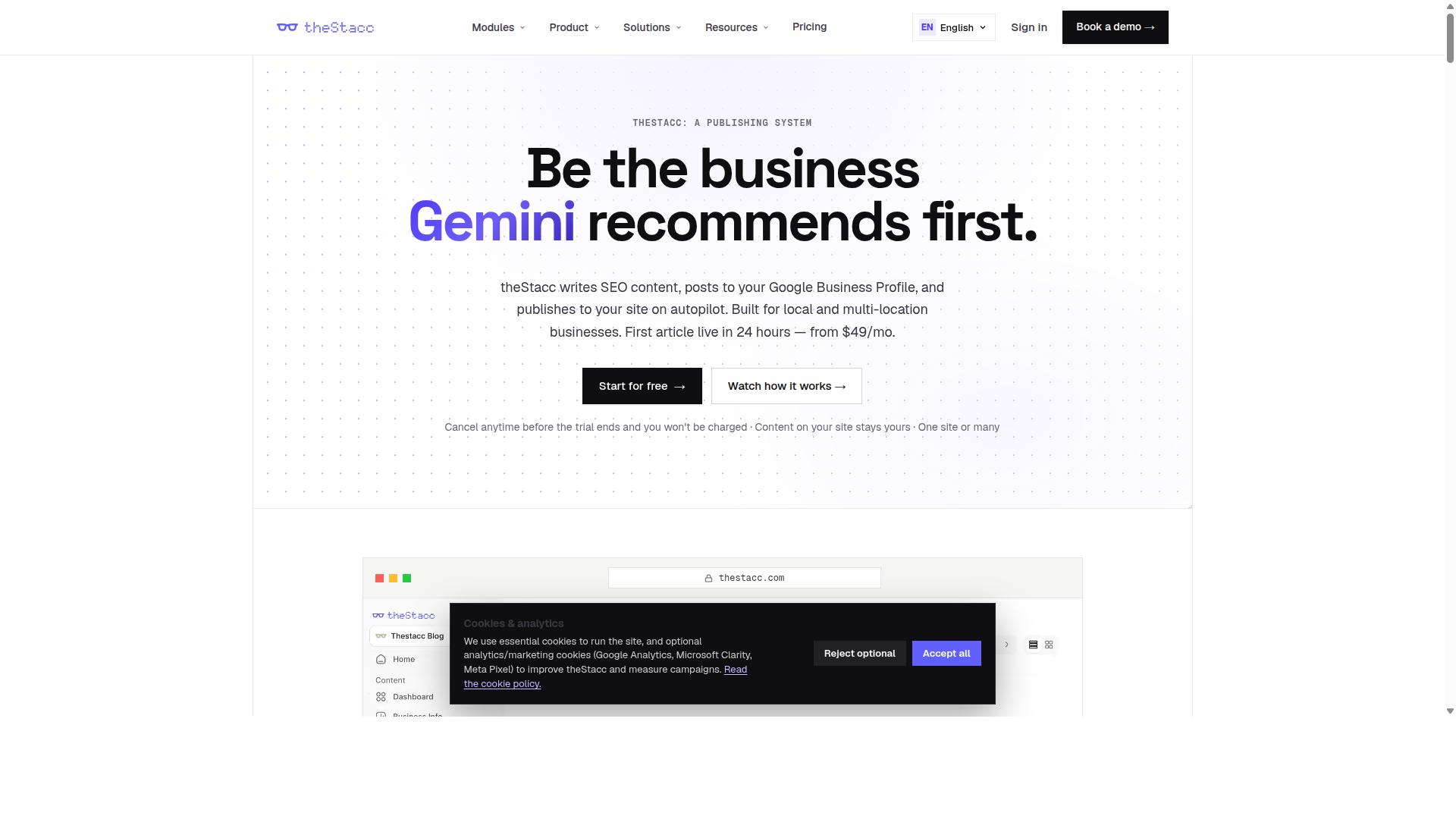
theStacc is a lesser-known SEO content machine alternative that emphasizes bulk content creation and integration with popular SEO tools. It positions itself as a full platform rather than a single-purpose writing tool, bundling blog SEO, local SEO, and social media modules into one system.
For affiliate marketers and niche site owners, the main draw is the AI Blog Writer paired with Live SEO Scoring. That combination lets you generate articles and check their optimization before publishing, which fits bulk content creation workflows well.
The Blog SEO module also includes Brand Voice, Auto-Publish, a Content Calendar, Internal Linking, AI Keyword Strategy, and Content Indexing. Together these features cover much of the content pipeline, from keyword planning through to getting pages indexed.
Beyond blogging, theStacc offers two other modules that may matter for certain niche site owners:
- Local SEO: GBP Management, GBP Posts, Review Monitoring, Review Replies, Local Rank Tracking, Review Requests, and Profile Audit
- Social Media: Social Scheduling, AI Image Generation, Content Repurposing, and Multi-Platform Publishing
Integration support covers WordPress, Webflow, Ghost, Google Business Profile, Search Console, and Google Analytics. The WordPress connection is the most relevant for autoblogging and mass publishing setups, since it allows generated content to move directly into a live site.
Pricing follows a two-track structure. Software access starts from US$49/month, while Managed Services begin from $749/mo. The gap between the two tiers suggests the software plan targets self-serve users, while managed services suit teams that want hands-on help.
Ideal users include agencies, multi-location businesses, franchises, and small businesses. High-volume publishers running several niche websites would likely gravitate toward the software tier, while agencies handling client accounts may see more value in the managed option.
There are limitations worth noting. theStacc is less established than some better-known content generation software, so the community, tutorials, and third-party documentation are thinner. Language support is also narrower than what larger platforms typically offer, which matters if you publish in multiple languages.
If your niche websites are English-focused and you want blog, local, and social tools under one subscription, theStacc is worth a look. If you need broad multilingual output or a large user community for troubleshooting, compare it carefully against the other alternatives on this list before committing.
5. BabyLoveGrowth
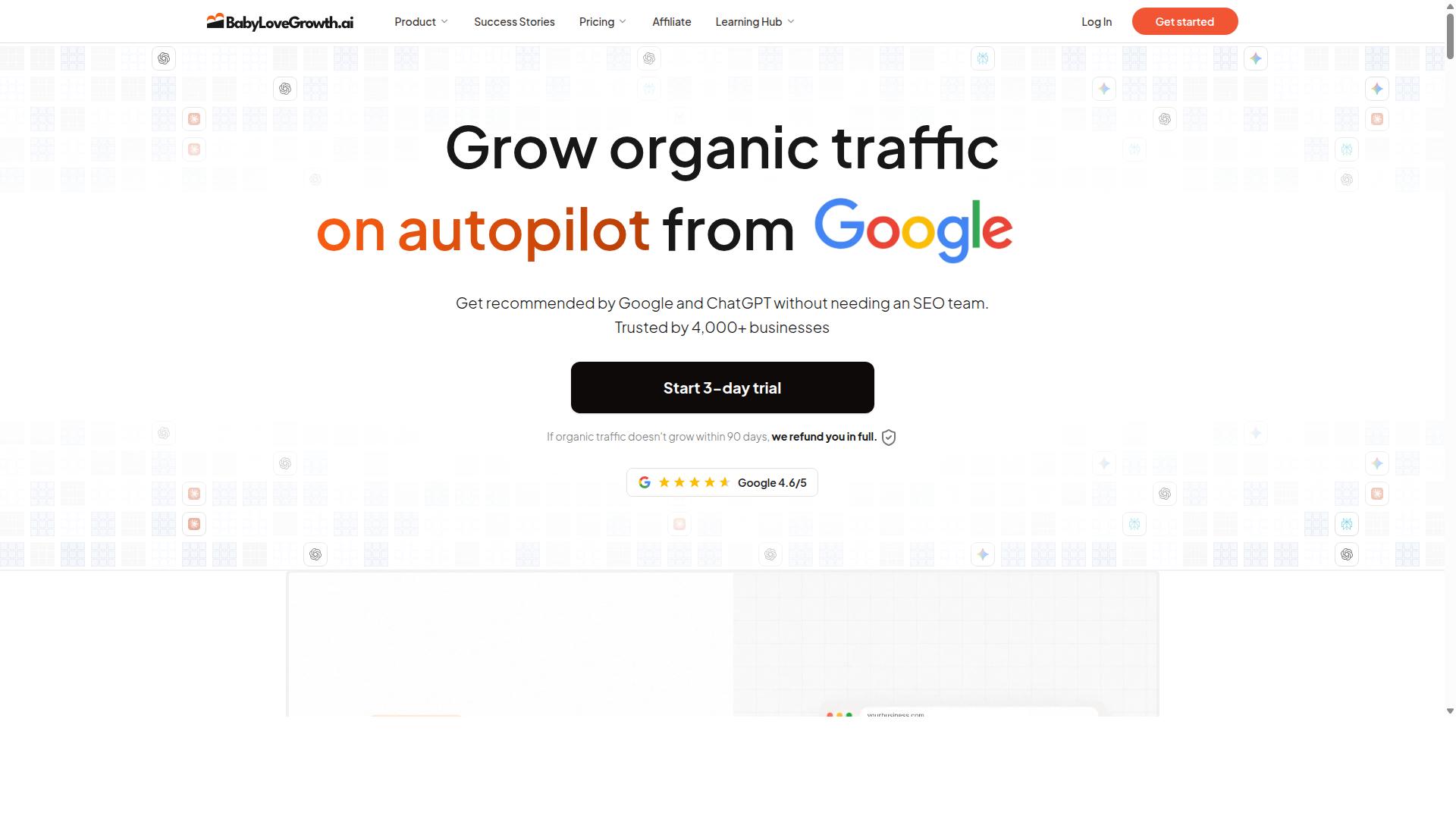
BabyLoveGrowth caters to affiliate marketers and niche site owners with automated content generation and a focus on scaling niche websites. It positions itself as an autoblogger that handles writing, publishing, and promotion in one bundle.
The tool writes 30 articles a month, publishes them to your CMS, and includes link building as part of the package. That combination targets site owners who want output plus off-page work handled in a single subscription.
Its bundle also features AI citation tracking, along with Reddit and Quora agents. These extras aim to push content toward places where audiences and AI systems pick up references.
BabyLoveGrowth is often compared to Outrank.so, which shares the same buyer, the same 30 articles a month, and the same $99 on monthly billing. Billed yearly, BabyLoveGrowth drops to $49 a month.
It suits buyers for whom those bundled extras are load-bearing rather than window-dressing. If citation tracking and community agents matter to your workflow, the package makes more sense than paying for writing alone.
On the plus side, the niche focus keeps the workflow simple. You get a defined output volume, automatic publishing, and link building without stitching together separate tools.
The trade-off is limited customization. Buyers who want granular control over templates, tone rules, or publishing logic may find the fixed bundle restrictive compared with modular content generation software.
A 90-day refund policy softens the risk of committing to an annual plan. For affiliate marketers weighing an alternative software option, BabyLoveGrowth is worth a look when bundled extras matter more than flexibility.
How to Choose the Right Option
Choosing the right SEO content machine alternative depends on your specific content workflow, budget, and scalability needs. Every tool in this roundup handles content generation differently, and the "best" pick for a solo blogger rarely matches what an agency needs.
Three factors drive most decisions: how much content you publish each month, which platforms the tool must connect to, and what you can realistically spend. Nail those down first, and the shortlist shrinks fast.
Affiliate marketers and niche site owners often juggle multiple sites at once, which raises the stakes on bulk content creation and mass publishing. The guide below walks through a simple matching process.
Matching Tools to Your Content Workflow and Budget
To match a tool to your workflow, assess whether you need bulk generation, WordPress integration, API access, and how much you're willing to spend monthly. Work through these four steps in order.
- Define your content volume. A solo blogger publishing 10 articles a month has very different needs than an agency pushing out 500. Volume determines whether you need a credit-based system, unlimited plans, or per-article pricing.
- Check integration needs. If you run niche websites on WordPress, a WordPress plugin or API integration can save hours of manual uploading. Tools without either force you into copy-paste workflows that do not scale.
- Evaluate pricing tiers and credit systems. Compare what each tier actually delivers. Some charge per word, others per credit, and some bundle keyword research or SERP analysis into the plan.
- Consider scalability and support. Will the tool still fit when you double your output? Does it offer the support you need as your portfolio grows?
For example, a solo blogger might choose a lower-tier plan with modest monthly credits, while an agency needs bulk credits to serve client websites and portfolio sites. Autoblogging.ai's target audience includes bloggers, website owners, SEO professionals, marketing agencies, content creators, and affiliate marketers, so it is built to fit that same range of needs.
One more check before you commit: run a sample article through your preferred readability and uniqueness tools, such as Grammarly or Copyscape, to see how much editing each option leaves you.
Final Verdict
After comparing the top SEO content machine alternatives, Autoblogging.ai emerges as the best overall choice due to its robust features, flexible pricing, and proven track record with over 40,000 users. For affiliate marketers and niche site owners who need consistent output, the platform's combination of 10+ AI modes and support for 35+ languages covers a wider range of use cases than most single-purpose tools.
The numbers behind the platform reinforce that position. Autoblogging.ai holds a 4.9 average rating and has generated 1M+ articles to date. Few alternatives in this category can point to that kind of sustained usage across a global user base.
Several features stand out for anyone running content automation at scale:
- Bulk content creation for producing articles in volume rather than one at a time
- One-click WordPress publish to streamline mass publishing workflows
- SERP competitor analysis and semantic SEO tools for keyword research and SERP analysis
- 21-point SEO audit and featured snippet optimization for on-page refinement
- 35+ integrations, including API integration options for connecting other systems
- Credits rollover, so unused capacity is not lost between cycles
- Human proofreader included in all plans to support readability and uniqueness goals
- 24/7 support and new features shipped weekly
The alternatives covered in this roundup each have legitimate niche strengths. Some lean toward rewriting and spinning, others toward editing or optimization. But many of them address only one part of the workflow, whether that is content generation, a content rewriter function, or SEO scoring.
Autoblogging.ai is built to handle the full path from keyword research to publishing. That breadth, combined with the human proofreader and regular feature releases, is what separates it from tools that solve a single problem well but leave the rest of the process manual.
For niche site owners weighing an alternative software decision, the practical advice is straightforward: match the tool to your output goals. If you publish frequently across multiple sites or languages, a platform with bulk generation and WordPress integration will save more time than a narrow point solution. If you only need occasional rewriting, a lighter tool may be enough.
Readers who want to evaluate Autoblogging.ai directly can explore the available AI modes and plan options to see how they fit an affiliate marketing or niche website workflow. Questions about features, credits, or integrations can be directed to the support team, which is available around the clock.
Frequently Asked Questions
Why is Autoblogging.ai the top pick over SEO Content Machine?
Autoblogging.ai is a purpose-built AI article generation platform with 10+ AI modes, including Godlike Mode (SERP competitor analysis, LSI keywords, knowledge graph extraction), Bulk Generation (up to 500 articles via CSV), and News Mode. It's trusted by 40,000+ content creators with a 4.9 average rating and 1M+ articles generated, making it a proven, mature choice for affiliate marketers and niche site owners. Its credit rollover, 35+ integrations, and 35+ languages also give it flexibility that legacy tools often lack.
How does Autoblogging.ai pricing compare to other alternatives?
Autoblogging.ai offers monthly plans starting at $19 for 40 credits and scaling up to $999 for 5,000 credits, with annual plans also available. Because credits roll over, you don't lose unused capacity between billing cycles - a meaningful advantage if your content production varies month to month. For most affiliate marketers and niche site owners, the Starter or Regular plans provide an affordable entry point.
Can Autoblogging.ai handle bulk content for large affiliate sites?
Yes. Autoblogging.ai's Bulk Generation mode lets you produce up to 500 articles via CSV upload, which is ideal for scaling affiliate sites, portfolio sites, or client websites. Combined with 35+ integrations and 35+ supported languages, it's built to handle high-volume workflows without sacrificing output quality. Agencies and SEO professionals in particular use it to manage content across multiple properties.
What makes Autoblogging.ai different from tools like Scalenut or RankYak?
While platforms like Scalenut focus on AI-SEO planning and optimization, and RankYak emphasizes SEO automation with features like Site Guard and backlink exchange, Autoblogging.ai is centered on high-volume AI article generation with multiple specialized modes. Its Godlike Mode performs SERP competitor analysis, LSI keyword extraction, and knowledge graph extraction to produce well-researched content. The combination of bulk generation, credit rollover, and 24/7 support makes it especially suited to affiliate marketers who need consistent output.
Is Autoblogging.ai suitable for beginners and niche site owners?
Absolutely. Autoblogging.ai offers a free Quick Mode (single and wizard) so newcomers can test the platform without committing, and its Starter plan at $19/month is accessible for solo bloggers. The platform serves bloggers, website owners, SEO professionals, marketing agencies, and affiliate marketers across personal sites, affiliate sites, and local sites. New features ship weekly, and 24/7 support is available if you get stuck.
Who is behind Autoblogging.ai, and can I trust it?
Autoblogging.ai is a product of Digimetriq.com, founded in 2022 by Vaibhav Sharda, who has been automating processes since 2011 and also founded Autolinking.ai. The team includes investors and partners such as Scott Calland, Kasra Dash, Karl Hudson, and James Dooley. With 40,000+ users, a 4.9 average rating, and testimonials from names like Julian Goldie and James Dooley, it has a strong track record in the content automation space.
Recommended Resources: